Get started
Introduction
Section titled “Introduction”The goal of the b3gbi package (B3 General Biodiversity Indicators) is to provide standardized, automated, and reproducible workflows for calculating essential spatial and temporal biodiversity indicators. Developed as part of the EU-funded B3 (Biodiversity Building Blocks for Policy) project, b3gbi takes pre-processed GBIF occurrence cubes as input and quickly transforms them into actionable metrics, including richness, evenness, rarity, taxonomic distinctness, Shannon-Hill diversity, Simpson-Hill diversity, and completeness, complete with integrated uncertainty estimation using robust bootstrapping methods.
This tutorial will guide you through the three core steps of the b3gbi workflow:
- Data Ingestion: Preparing your GBIF data cube with
process_cube(). - Indicator Calculation: Using indicator-specific wrapper functions.
- Visualization: Plotting the results as maps or time series using the generic
plot()function.
Package Installation
Section titled “Package Installation”The package is available on the dedicated B-Cubed R-universe repository.
# Install the package from the dedicated R-universeinstall.packages("b3gbi", repos = "https://b-cubed-eu.r-universe.dev")
# Load the packagelibrary(b3gbi)
Step 1: Data Ingestion with process_cube()
Section titled “Step 1: Data Ingestion with process_cube()”The first step is importing your GBIF occurrence cube (a .csv file) and converting it into a structured processed_cube object. This function automatically validates the input and attempts to autodetect column names and grid types.
Key process_cube() Arguments
Section titled “Key process_cube() Arguments”| Argument | Description | Default/Details |
|---|---|---|
data | Path to the .csv file containing the GBIF cube. Required. | |
grid_type | The grid system used (e.g., ‘eea’, ‘mgrs’, ‘eqdgc’, ‘isea3h’, ‘custom’). | Autodetected if possible. |
first_year | Filters the cube to start at this year. | First year in the data. |
last_year | Filters the cube to end at this year. | Last year in the data. |
Note on Column Names: The function automatically attempts to detect required columns (like cell code, year, species key). You only need to manually specify arguments like cols_year or cols_cellCode if your column names deviate from expected standards.
Example: Import Data and Filter by Time
Section titled “Example: Import Data and Filter by Time”Here we import an example cube of mammals in Denmark, filtering the data to start from 1980.
# Function 1: process_cube()denmark_cube <- process_cube(  system.file("extdata",    "denmark_mammals_cube_eqdgc.csv",    package = "b3gbi"  ),  first_year = 1980) # Filter the cube to start at 1980
# Printing the object shows key metadatadenmark_cube#>#> Processed data cube for calculating biodiversity indicators#>#> Date Range: 1980 - 2024#> Single-resolution cube with cell size 0.25degrees#> Number of cells: 323#> Grid reference system: eqdgc#> Coordinate range:#>  xmin  xmax  ymin  ymax#>  3.25 15.75 54.25 58.25#>#> Total number of observations: 204664#> Number of species represented: 100#> Number of families represented: 31#>#> Kingdoms represented: Animalia#>#> First 10 rows of data (use n = to show more):#>#> # A tibble: 30,985 × 15#>     year cellCode  kingdomKey kingdom  familyKey family        taxonKey scientificName   obs#>    <dbl> <chr>          <dbl> <chr>        <dbl> <chr>            <dbl> <chr>          <dbl>#>  1  1980 E008N55CB          1 Animalia      5310 Phocidae       2434793 Phoca vitulina     1#>  2  1980 E008N56BB          1 Animalia      5307 Mustelidae     5218987 Mustela nival…     1#>  3  1980 E008N57DC          1 Animalia      9361 Phocoenidae    2440669 Phocoena phoc…    27#>  4  1980 E009N55BB          1 Animalia      5722 Erinaceidae    5219616 Erinaceus eur…     1#>  5  1980 E009N56BB          1 Animalia      9368 Vespertilion…  5218507 Plecotus auri…     1#>  6  1980 E009N57DD          1 Animalia      9361 Phocoenidae    2440669 Phocoena phoc…     1#>  7  1980 E010N55AA          1 Animalia      5310 Phocidae       2434793 Phoca vitulina     1#>  8  1980 E010N55AA          1 Animalia      5307 Mustelidae     5219019 Mustela ermin…     1#>  9  1980 E010N55BB          1 Animalia      5310 Phocidae       2434793 Phoca vitulina     1#> 10  1980 E010N56CB          1 Animalia      5307 Mustelidae     5218887 Martes foina       1#> # ℹ 30,975 more rows#> # ℹ 6 more variables: minCoordinateUncertaintyInMeters <dbl>, minTemporalUncertainty <dbl>,#> #   familyCount <dbl>, xcoord <dbl>, ycoord <dbl>, resolution <chr>
The data itself is stored in a tibble within the object’s data slot, and the rest is metadata.
str(denmark_cube)#> List of 11#> $ first_year : num 1980#> $ last_year : num 2024#> $ coord_range :List of 4#> ..$ xmin: num 3.25#> ..$ xmax: num 15.8#> ..$ ymin: num 54.2#> ..$ ymax: num 58.2#> $ num_cells : int 323#> $ num_species : int 100#> $ num_obs : num 204664#> $ kingdoms : chr "Animalia"#> $ num_families: int 31#> $ grid_type : chr "eqdgc"#> $ resolutions : chr "0.25degrees"#> $ data : tibble [30,985 × 15] (S3: tbl_df/tbl/data.frame)#> ..$ year : num [1:30985] 1980 1980 1980 1980 1980 1980 1980 1980 1980 1980 ...#> ..$ cellCode : chr [1:30985] "E008N55CB" "E008N56BB" "E008N57DC" "E009N55BB" ...#> ..$ kingdomKey : num [1:30985] 1 1 1 1 1 1 1 1 1 1 ...#> ..$ kingdom : chr [1:30985] "Animalia" "Animalia" "Animalia" "Animalia" ...#> ..$ familyKey : num [1:30985] 5310 5307 9361 5722 9368 ...#> ..$ family : chr [1:30985] "Phocidae" "Mustelidae" "Phocoenidae" "Erinaceidae" ...#> ..$ taxonKey : num [1:30985] 2434793 5218987 2440669 5219616 5218507 ...#> ..$ scientificName : chr [1:30985] "Phoca vitulina" "Mustela nivalis" "Phocoena phocoena" "Erinaceus europaeus" ...#> ..$ obs : num [1:30985] 1 1 27 1 1 1 1 1 1 1 ...#> ..$ minCoordinateUncertaintyInMeters: num [1:30985] 3 1000 1000 50 1000 1000 3 930 3 92 ...#> ..$ minTemporalUncertainty : num [1:30985] 86400 86400 86400 86400 2678400 ...#> ..$ familyCount : num [1:30985] 39284 23427 19402 3807 16848 ...#> ..$ xcoord : num [1:30985] 8.38 8.88 8.62 9.88 9.88 ...#> ..$ ycoord : num [1:30985] 55.4 56.9 57.1 55.9 56.9 ...#> ..$ resolution : chr [1:30985] "0.25degrees" "0.25degrees" "0.25degrees" "0.25degrees" ...#> - attr(*, "class")= chr "processed_cube"Step 2: Indicator Calculation
Section titled “Step 2: Indicator Calculation”The package provides numerous wrappers to calculate indicators as either maps (spatial distribution) or time series (temporal trends).
Available Indicators
Section titled “Available Indicators”Use available_indicators to see the full list of indicators and their associated wrapper functions (e.g., obs_richness_map, total_occ_ts).
available_indicators#>#>#> Available Indicators#>#>#> 1. [0;31mObserved Species Richness[0m#> Class: obs_richness#> Calculate map: yes, e.g. obs_richness_map(my_data_cube)#> Calculate time series: yes, e.g. obs_richness_ts(my_data_cube)#> Additional map function arguments: NA#> Additional time series function arguments: NA#>#> 2. [0;31mTotal Occurrences[0m#> Class: total_occ#> Calculate map: yes, e.g. total_occ_map(my_data_cube)#> Calculate time series: yes, e.g. total_occ_ts(my_data_cube)#> Additional map function arguments: NA#> Additional time series function arguments: NA#>#> 3. [0;31mPielou's Evenness[0m#> Class: pielou_evenness#> Calculate map: yes, e.g. pielou_evenness_map(my_data_cube)#> Calculate time series: yes, e.g. pielou_evenness_ts(my_data_cube)#> Additional map function arguments: NA#> Additional time series function arguments: NA#>#> 4. [0;31mWilliams' Evenness[0m#> Class: williams_evenness#> Calculate map: yes, e.g. williams_evenness_map(my_data_cube)#> Calculate time series: yes, e.g. williams_evenness_ts(my_data_cube)#> Additional map function arguments: NA#> Additional time series function arguments: NA#>#> 5. [0;31mCumulative Species Richness[0m#> Class: cum_richness#> Calculate map: no#> Calculate time series: yes, e.g. cum_richness_ts(my_data_cube)#> Additional map function arguments: NA#> Additional time series function arguments: NA#>#> 6. [0;31mDensity of Occurrences[0m#> Class: occ_density#> Calculate map: yes, e.g. occ_density_map(my_data_cube)#> Calculate time series: yes, e.g. occ_density_ts(my_data_cube)#> Additional map function arguments: NA#> Additional time series function arguments: NA#>#> 7. [0;31mAbundance-Based Rarity[0m#> Class: ab_rarity#> Calculate map: yes, e.g. ab_rarity_map(my_data_cube)#> Calculate time series: yes, e.g. ab_rarity_ts(my_data_cube)#> Additional map function arguments: NA#> Additional time series function arguments: NA#>#> 8. [0;31mArea-Based Rarity[0m#> Class: area_rarity#> Calculate map: yes, e.g. area_rarity_map(my_data_cube)#> Calculate time series: yes, e.g. area_rarity_ts(my_data_cube)#> Additional map function arguments: NA#> Additional time series function arguments: NA#>#> 9. [0;31mMean Year of Occurrence[0m#> Class: newness#> Calculate map: yes, e.g. newness_map(my_data_cube)#> Calculate time series: yes, e.g. newness_ts(my_data_cube)#> Additional map function arguments: NA#> Additional time series function arguments: NA#>#> 10. [0;31mTaxonomic Distinctness[0m#> Class: tax_distinct#> Calculate map: yes, e.g. tax_distinct_map(my_data_cube)#> Calculate time series: yes, e.g. tax_distinct_ts(my_data_cube)#> Additional map function arguments: NA#> Additional time series function arguments: NA#>#> 11. [0;31mSpecies Richness (Estimated by Coverage-Based Rarefaction)[0m#> Class: hill0#> Calculate map: yes, e.g. hill0_map(my_data_cube)#> Calculate time series: yes, e.g. hill0_ts(my_data_cube)#> Additional map function arguments: cutoff_length, coverage#> Additional time series function arguments: cutoff_length, coverage#>#> 12. [0;31mHill-Shannon Diversity (Estimated by Coverage-Based Rarefaction)[0m#> Class: hill1#> Calculate map: yes, e.g. hill1_map(my_data_cube)#> Calculate time series: yes, e.g. hill1_ts(my_data_cube)#> Additional map function arguments: cutoff_length, coverage#> Additional time series function arguments: cutoff_length, coverage#>#> 13. [0;31mHill-Simpson Diversity (Estimated by Coverage-Based Rarefaction)[0m#> Class: hill2#> Calculate map: yes, e.g. hill2_map(my_data_cube)#> Calculate time series: yes, e.g. hill2_ts(my_data_cube)#> Additional map function arguments: cutoff_length, coverage#> Additional time series function arguments: cutoff_length, coverage#>#> 14. [0;31mSpecies Occurrences[0m#> Class: spec_occ#> Calculate map: yes, e.g. spec_occ_map(my_data_cube)#> Calculate time series: yes, e.g. spec_occ_ts(my_data_cube)#> Additional map function arguments: none#> Additional time series function arguments: none#>#> 15. [0;31mSpecies Range[0m#> Class: spec_range#> Calculate map: yes, e.g. spec_range_map(my_data_cube)#> Calculate time series: yes, e.g. spec_range_ts(my_data_cube)#> Additional map function arguments: none#> Additional time series function arguments: none#>#> 16. [0;31mOccupancy Turnover[0m#> Class: occ_turnover#> Calculate map: no#> Calculate time series: yes, e.g. occ_turnover_ts(my_data_cube)#> Additional map function arguments: none#> Additional time series function arguments: noneCore Arguments for Wrapper Functions
Section titled “Core Arguments for Wrapper Functions”All indicator wrapper functions (e.g., obs_richness_map, occ_turnover_ts) share the following key arguments:
| Argument | Description | Details |
|---|---|---|
data | The processed_cube object. Required. | |
level | The geographical scale (‘country’, ‘continent’, ‘world’). | Automatically retrieves boundaries. |
region | The specific region name (e.g., ‘Germany’, ‘Europe’). | Required if level is set. |
ci_type | Type of bootstrap confidence interval to calculate. Only relevant for time series. | ‘norm’, ‘basic’, ‘perc’, ‘bca’, or ‘none’. Defaults to ‘norm’ for time series. |
num_bootstrap | Number of bootstrap runs for CI calculation. Only relevant for time series. | Defaults to 100. |
Important Note on Confidence Intervals (CIs):
- The
ci_typeargument is only used for calculating uncertainty in general time series indicators (e.g.,obs_richness_ts) and is ignored for map indicators. - For indicators based on Hill diversity (e.g.,
hill_ts()), theci_typeis ignored because CIs are calculated internally using the iNEXT package. However, thenum_bootstrapargument is still required to define the number of runs for iNEXT’s internal uncertainty estimation.
Example: Observed Species Richness Map
Section titled “Example: Observed Species Richness Map”Let’s calculate the observed richness spatially, covering the period from 1980 to the end of the cube’s data.
# Calculate a gridded map of observed species richness for Denmark# Note that ci_type is ignored for map indicatorsDenmark_observed_richness_map <- obs_richness_map(denmark_cube, level = "country", region = "Denmark")The result is an indicator_map object (the data within it is also an sf object, containing geographical information).
class(Denmark_observed_richness_map)#> [1] "indicator_map" "obs_richness"class(Denmark_observed_richness_map$data)#> [1] "indicator_data" "sf" "data.frame"Example: Total Occurrences Time Series
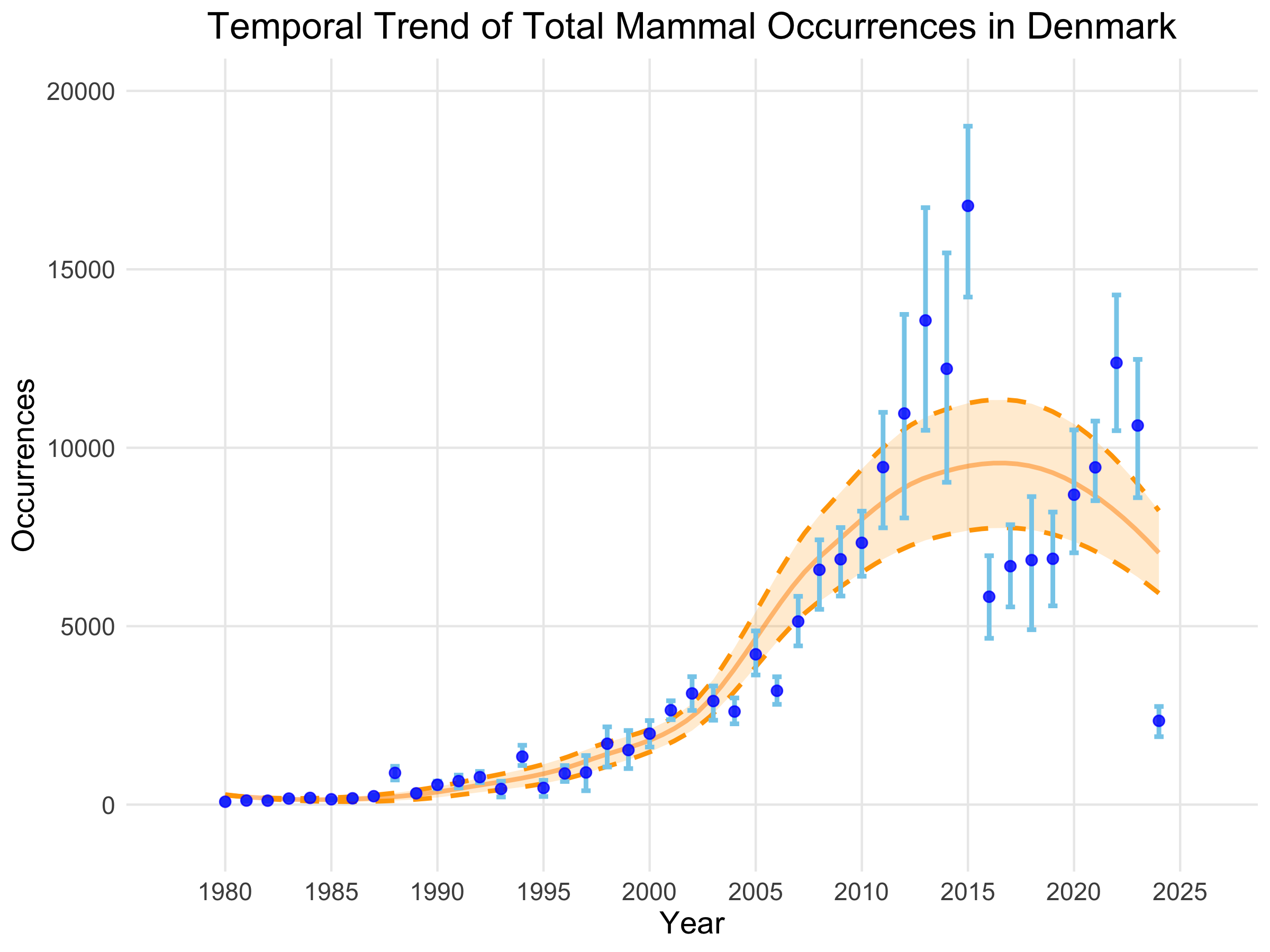
Section titled “Example: Total Occurrences Time Series”Now, let’s calculate the same indicator temporally for a trend analysis. We will use the default ci_type = "norm" and num_bootstrap = 100.
# Calculate a time series of total occurrences for DenmarkDenmark_total_occ_ts <- total_occ_ts(denmark_cube, level = "country", region = "Denmark", ci_type = "norm", # Include confidence intervals num_bootstrap = 100) # Using the default number of runsThe result is an indicator_ts object.
class(Denmark_total_occ_ts)#> [1] "indicator_ts" "total_occ"Step 3: Visualization with plot()
Section titled “Step 3: Visualization with plot()”The generic plot() function automatically calls the appropriate helper function (plot_map() or plot_ts()) and applies smart defaults for titles, colors, and layout.
Plotting the Map
Section titled “Plotting the Map”| Argument | Description | Common Use |
|---|---|---|
title | Sets the plot title. | e.g., “Observed Richness in Denmark” |
legend_title | Sets the legend title. | e.g., “Number of Species” |
crop_to_grid | If TRUE, the map edges are determined by the grid extent. | |
crop_by_region | If TRUE, map edges are determined by the map region selected during indicator calculation, rather than the data. |
# Plotting the map objectplot(Denmark_observed_richness_map, legend_title = "Mammal Species Count", title = "Observed Mammal Richness (1980-Present)")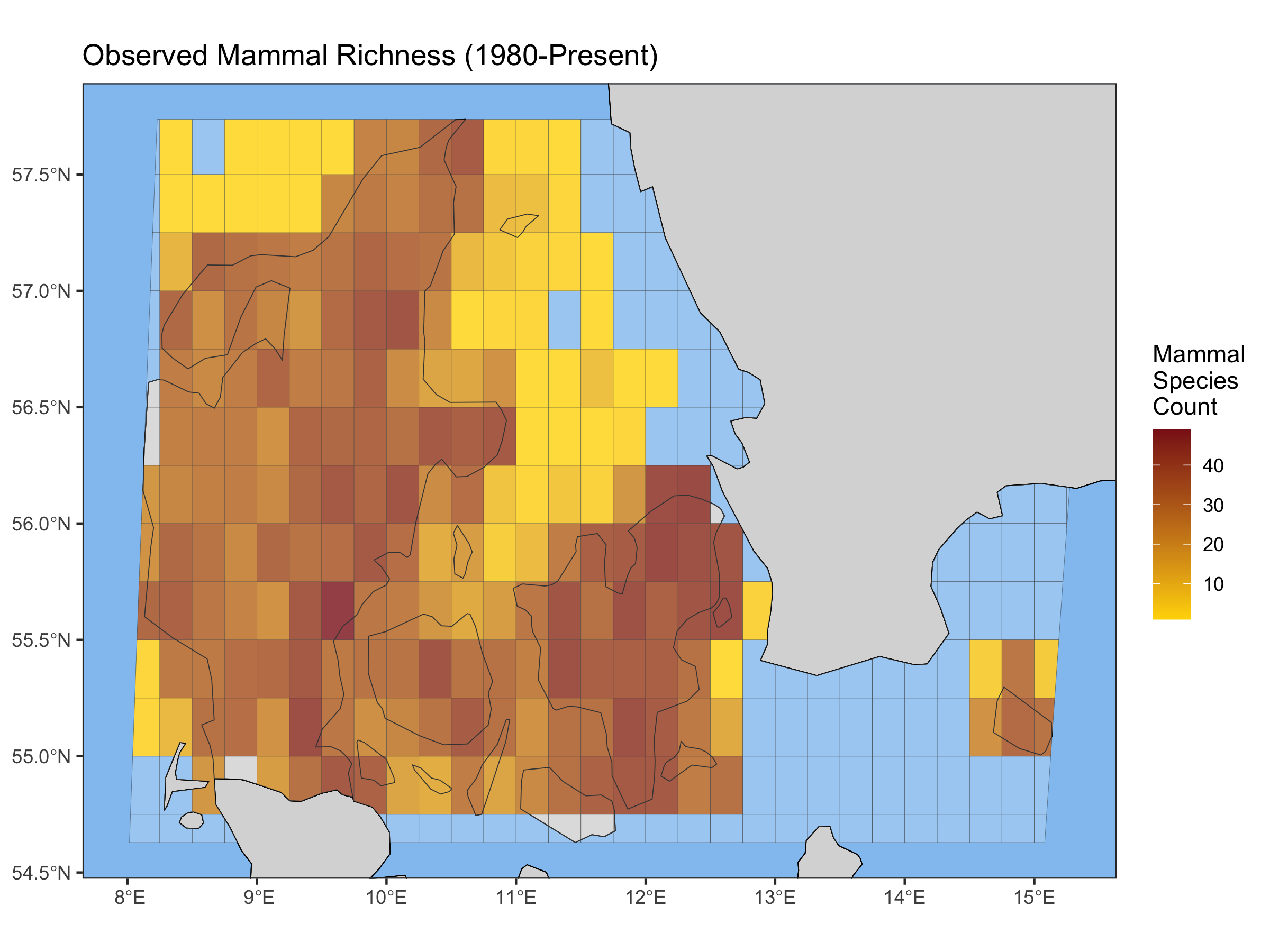
Plotting the Time Series
Section titled “Plotting the Time Series”| Argument | Description | Common Use |
|---|---|---|
smoothed_trend | If TRUE, displays a smoothed trend line (LOESS). | Defaults to TRUE. |
linecolour | Sets the color of the indicator line/points. | e.g., “blue” |
ribboncolour | Sets the color of the indicator confidence interval. | e.g., “skyblue” |
trendlinecolour | Sets the color of the trend line. | e.g., “darkorange” |
envelopecolour | Sets the color of the trend line confidence intervals. | e.g., “orange” |
x_label / y_label | Custom labels for the axes. |
# Plotting the time series objectplot(Denmark_total_occ_ts, title = "Temporal Trend of Total Mammal Occurrences in Denmark", linecolour = "blue", ribboncolour = "skyblue", trendlinecolour = "darkorange", envelopecolour = "orange", smoothed_trend = TRUE)